Sunday, April 3, 2011

True Life Story: The Gypsy Mystery Arts Studio and My Evolving Method

There be dragons here!
Our house (known fondly as the 'Technicolor Cottage') has become a fine art screen printing shop. 

  It’s everywhere.  In the living room are folding work tables, paints, inks and other art supplies, shipping tubes, a mat cutter, a printing press, and silk screens stacked against the walls.  The sofa and TV manage to squeeze in as well.  The bathtub is used as much for cleaning screens as it is for cleaning us.  The ‘dining room’ is half-filled with shelves and racks to store finished art and more art supplies. Dore’s garage has become an ever-evolving facility for coating and exposing screens. 
a fresh sheet of paper
          We are getting better at the process, but it can be complicated – lots of little things can go wrong, and have.  So far, we have both made more mistakes than perfect finished products.  But the ones that do turn out are turning out great, and we’re getting better with every try.

     My initial choice of substrate for my screen prints was heavy (140 lb.) watercolor paper, on which I hand-painted a background in acrylic paints.  After many frustrating printing issues, which I determined are 
painting the background with pastels
caused by the heavy paper warping slightly and sticking to the screen (ruining numerous painted backgrounds in the process), I decided to try a different substrate.
        I’d done a small run of prints on colored fine art paper (Canson Mi-Teintes) and the printing had gone much more smoothly, especially when I sprayed the press surface with a temporary adhesive that held the lighter-weight paper securely in place (the adhesive was not quite strong enough to hold onto the heavier paper). 
      The Mi-Teintes paper comes in a variety of colors and has a nice texture and was perfect for working with pastels.  I decided to try painting my backgrounds on this lighter paper with pastels, and it seems to have solved the printing problems I was having.  

the finished background
            For each piece, I trim the paper, then measure out and mark the image area. I mask off the edges of the image area, using scrap paper to shield the paper beyond the tape.  Using soft pastels, I layer colors over the paper’s base color, blending and smudging to create a background that has variation and interest, but is not too distracting.  The background needs to maintain a certain value level in order to let the metallic gold ink really shine.  The pastels actually enhance this effect, as they have a very matte, velvety finish that contrasts beautifully with the shimmering gold of the printed design.
   Once the pastel work is done, I spray it with a fixative to prevent further smudging, and remove the masking.

            Next comes the actual screen printing.  Dore built the press, which is a sort of box with a laminated surface and a pair of Speedball clamp hinges.  He has also taken charge of making the screens (a process fraught with its own technical difficulties and nuances to master). 

gold ink along top of screen
            The screen is clamped into the hinges and I determine how to line up my paper to center the design within the square of background. I mark the corner position with tape and spray a light coat of spray-mount to secure the background paper.

            The screen is pulled down and ink (which is about the consistency of creamy peanut butter) is applied along the upper edge of the screen above the image.  Using a wide squeegee, the ink is pulled down across the screen, pushing a thin layer of ink through the stencil.
Final print

  VoilĂ !  
The gold ink gleams against a vibrant field of swirling color.  Each print is then numbered, titled and signed.

Wednesday, March 30, 2011

Art Spotlight: 'Aum Awakening'

'Aum Awakening' by Cristina McAllister

'Aum' or "Om' with wings.
“The “Aum” symbol is said to represent the pure sound of Creation and the singularity of God – a mystical syllable sacred to Buddhists, Hindus, Sikhs and Jains.  It is often a part of yogic practice and is chanted as a mantra to facilitate meditation.
Lotus, stars, hearts.
     The lotus flower begins as a humble bulb in the muck at the bottom of a pond, growing toward the surface to emerge into luminous full bloom.  This rising toward the light has been likened to the spiritual journey of a soul seeking enlightenment, and the unfolding lotus blossom has become a symbol of spiritual awakening.Wings represent ascension, freedom, divinity, transcendence.  Stars embody the heavens, celestial motion, lights in the darkness.  Hearts symbolize compassion, love, emotion and truth.
            ‘Aum Awakening’ is a visual mantra that expresses the desire to rise above our mundane troubles and connect with our highest potential and the primordial vibration. 

Fine art prints of this design are available here:
http://fineartamerica.com/featured/aum-awakening-mandala-cristina-mcallister.html

Tuesday, March 29, 2011

Art Spotlight: 'Enlightenment'

'Enlightenment' by Cristin McAllister
This piece expresses the concept of spiritual growth and maturity.
            The central figure, the lotus plant, begins life at the dark, muddy bottom of a pond, growing up toward the surface to eventually break into the light and blossom into a beautiful, fragrant flower. According to Buddhist lore, this process reflects the soul's journey from the darkness of ignorance and materialism, through experience and learning, into the uplifting radiance of enlightenment.
            The thorny brambles tangled at the bottom represent confusion and the struggles of mundane life.  The winged heart represents the ability to rise above such tribulations and achieve serenity.
            The sun is emblazoned with a swastika (from the Sanskrit svastika, meaning “auspicious sign”)  – a symbol of the sun, of radiant life energy and blessing.  This very ancient symbol has been held sacred by cultures across the globe since the very beginning of human art. 
            Beams of sunlight with hands on the ends radiate from the sun’s disk, a depiction of the ancient Egyptian sun god Aten.  The hands offer ankh symbols, which represent the Life Force. Stars dot the heavens, images of light in the darkness.
            The butterfly begins life as a lowly caterpillar, wraps itself in a jewel-like chrysalis and eventually emerges as a delicate, colorful, soaring adult. Thus it has come to represent transformation, spiritual growth and rebirth among many cultures around the world.


 14” x 14” Variable Edition serigraphs of this design are now available on my Etsy shop.
“Variable Edition” means that each print of this design is unique, featuring hand-painted backgrounds with color and texture variations. 

Tuesday, March 22, 2011

Symbol Spotlight: Swastika

            What does this simple bent-armed cross mean to you?  Bigotry? Genocide?  Does it evoke images of Nazi war banners?  White supremacist skinhead tattoos?  Does it seem threatening, hateful…evil?
            Most Americans and Europeans these days associate the swastika with these malevolent concepts, but this “bad reputation” is a relatively recent development.  About 90 years ago, the Nazi Party chose to emblazon this symbol on their flags and uniforms, and then went on to commit heinous crimes against humanity. Because of this, the poor swastika came to represent fascism, cruelty, extreme racism and monstrous holocaust.

            This is incredibly unfortunate, because for the first, oh…several thousand years or so of its existence, it was one of the most widely-spread and auspicious symbols in the world.
            It was used by Neolithic peoples, making it one of mankind’s most ancient symbols. Since antiquity, it has been used by people in the Mediterranean, the Middle East, Asia, Africa, Europe and North and South Americas.  

Swastikas from around the globe.
        
            The name comes from the Sanskrit word svastika, which means ‘lucky or auspicious thing’, and indeed, most of the meanings associated with it (before Hitler) were very positive. 
            Visually, it is a melding of two very ancient and potent symbols; the cross and the spiral.  The cross, at its most basic, is an intersection, a crossroads, with lines that radiate out from the center.  A spiral is a single line leading outward from the center, curving around itself.  The combination of these shapes suggests outward expansion, energy radiating outward and spinning motion. 
            It is most commonly considered a solar symbol – representing the Sun with energy radiating from it. As the sun’s warmth and light are essential for life on our planet, sun signs are universally positive in nature, connoting a sacred Source of Life, Light and Abundance.  Some scholars connect the swastika’s dynamic shape with the rotation of the stars in the night sky.  It is also associated with Stability, because it points in all directions at once.
Hindu-style svastika
            According to the Illustrated Encyclopedia of Traditional Symbols, the swastika means: “..the union of the male and female principles; the dynamic and static; mobility and immobility; harmony and balance; the two complimentary phases of movement, centrifugal and centripetal, inbreathing and outbreathing, going out from and returning to the centre, beginning and end…In all circumstances it is the symbol of good luck; good augury; good wishes; blessings; longevity; fecundity; health and life.”

            In the Hindu tradition, the swastika represents the very manifestation of the Universe.  A right-facing swastika represents the Evolution of the Universe, facing left, the Involution of the Universe; these two processes continuing in a balanced cycle of manifestation throughout eternity.  Swastikas are often painted near doorways and around the home to attract good fortune and well-being.
"Seal on Buddha's Heart"
            To Buddhists and Jains it represents Eternity, and is one of their most auspicious symbols, used in many rituals and holy texts.  Once known as the “Seal on Buddha’s Heart”, it was commonly placed over the heart or in the palm of the Buddha’s hand on statues and paintings. It was regarded as a highly favorable talisman evoking thoughts of reverence, serenity and good fortune. Unfortunately, many artists no longer use the symbol because of its more recent, negative associations.
            The ancient Chinese regarded the swastika as representing the Sun and the Whole of Creation. The Proto-Indo-Europeans considered it a good luck charm.
            Several Native American tribes used it to symbolize Life and Prosperity, and the Four Directions, or Four Winds.  To the Hopi, it represented the migratory path of their wandering tribe, and the Navaho associate it with a mythic spinning log used in healing rituals.
Native American basket
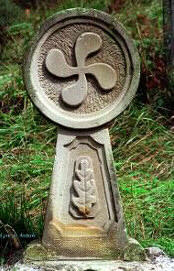
            It was used as a decorative element by the ancient Greeks and Romans, Mayans, Aztecs, Celts, Egyptians, Vikings, Basques and more. One theory posits that the almost ubiquitous commonality of this “crooked cross” came about because the shape is inherent in the patterns of square-woven baskets, which most early societies developed.
American good luck quilt
          
   In the Middle Ages, it was etched in catacombs to represent Christ and the Four Evangelists.  In 19th Century America, it was a popular motif on good luck quilts given as gifts to new brides. 
Basque tombstone

            In the late 19th century, German archeologist Heinrich Schliemann popularized the swastika as an ancient symbol of success and good fortune.  When the anti-Semitic “Aryan Master Race” movement began in the early 20th century, the swastika was appropriated as an icon that proclaimed “Aryan conquest and mastery”.  Sadly, this usage has tainted the swastika’s reputation ever since, practically obliterating the symbol’s long history of positive associations.

            Today, there is a movement to re-educate the world about this fascinating symbol and reclaim the swastika’s original significance.  If we take the long view of its extensive history and ubiquity, we realize that the Nazi association is truly a short-lived anomaly. 

"Enlightenment" by Cristina McAllister

Sources and further reading:

Tuesday, March 15, 2011

Work in Progress: 'Spring Queen'

'Spring Queen' in progress, by Cristina McAllister
Working on the second piece in my 'Queens of the Seasons' series.  The blobs and ovals are placeholders that I'll develop into more spring flowers.

The first piece in this series is the 'Harvest Queen'.

Wednesday, March 9, 2011

"P.L.U.R.: Peace, Love, Unity, Respect"

"PLUR" by Cristina McAllister
Peace. Love. Unity. Respect.
P.L.U.R.
This acronym originated in the rave subculture of the mid 80’s and early 90’s, which was influenced by the hippie peace movement of the 60’s.  It has emerged as a mantra and credo that is relevant to many people seeking to live conscious, connected lives.   
     It is the distillation of the basic ideals that numerous cultures and philosophies have sought to create a harmonious human society.
     It is linked to the notions of the Golden Rule (Treat others and you wish to be treated) and karma – the idea that what you put out into the world will be returned to you.  
      By being mindful of these ideals and applying them to interactions in our daily lives, we can become better people, and make the world a better place for all of us.

This hand-pulled screen print of my original design features a Peace sign, a heart representing Love, and two original icons; a circle of stylized people for Unity and an illustration of the namaste mudra – a gesture of Respect.

This is a variable edition on colored fine art paper, meaning different colors of paper are used throughout the edition.  Image size is 8” x 11.25”  and can be matted to fit a standard 12 x 16 frame.
Each print is numbered, titled and signed.

Now Available at my Etsy Shop!

See also: 'Art Spotlight: 'Good Karma"

Gypsy Angel

 Amy Clarke takes flight at the 2011 Los Angeles Burning Man Decom event.  She is standing in front of "The Garden" , an elaborate art piece painted on one side of Calliope The Wonder Wagon.
Photo by Alex Orlovsky

More pictures of Calliope: Calliope Gallery